Blindside x Liquid Architecture Sound Series 2026: Entangled Transmissions
Blindside Gallery, North Melbourne, Wurundjeri Country
03.09.26 — 26.09.26
It was a cloudy, brooding Wednesday afternoon in Melbourne. After chomping down a chicken sandwich at nearby wine bar Boire, I sauntered down Errol street and happened upon the Blindside x Liquid Architecture Sound Series 2026: Entangled Transmissions. This collaboration exhibited new works from four Naarm/Melbourne-based artists with a focus on sound and listening. Newly housed on Errol St in North Melbourne after moving from its longstanding home in the Nicholas Building, Blindside was completely empty, but the door was ajar. I walked in, guided by no one and nothing except my own curiosity.
Upon entering the gallery I felt a little unsure if I was intruding or if I had to be ushered into the space. The latter has been my experience when attending art galleries in the past. Typically, galleries have a front desk or ticket office, but here the staff desk was concealed by a wall behind the first two exhibits in the main room on the ground floor. This approach in modifying the configuration of gallery-goers was striking. It signalled a break from traditional gallery configurations and expresses to visitors more than a stylistic choice but a possibility: art can be experienced without mediation or introduction by humans.
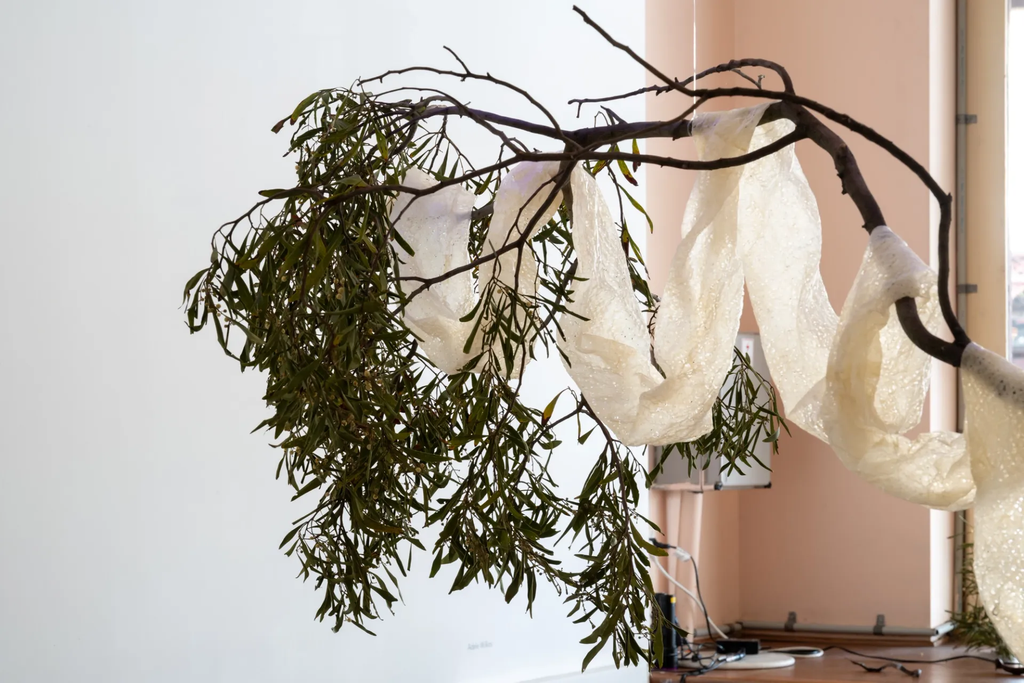
At first I was transfixed by a wattle tree-branch that spun slowly in the centre of the space, with a looped track of what sounded like cicadas, a gentle, stirring wind and the rustle of leaves in the background. The recording took place entirely in an entheogenic botanic garden (plants with psychoactive properties).¹ As I watched the branch I continued to think about how a fragment of the natural world was being brought into the gallery — a space which often abstracts us from the natural world and our surroundings. The work, featuring kozo bark lace paper to emulate the shedded skin of a python wrapped around a wattle-tree branch, came from Adele Wilkes, and was titled Ecdysis. Ecdysis refers to the biological process of shedding an outer layer.
As I moved through the space, I sat down to watch the video work Temperance: On Listening to Angels by Amaara Raheem. The work was a study between two dancers. It displayed carefully choreographed movements between the two. It was beautifully moving, there was a clear tension between the dancers. One stepped up a ladder, reaching, as if towards heaven almost. The dancer then climbed down the ladder, taken into an embrace by the second dancer. They would meet and separate throughout the video work, creating an atmosphere of suspense and ease. While watching the piece, I kept coming back to this feeling of tension that came out of the carefully choreographed movements between the two dancers in the video. The name of the work began to take on a personal meaning for me, as I tempered my soul in the process of seeing this tension between sound and body unfold between the dancers.
What is the relationship between sound and the body? This was a question that looped in my mind as the interplay between dancer and location took place before my eyes. Slowly, I felt myself becoming one with the dancers… becoming imbued with the very same spirit of temperance, collaboration and tension that performance evoked. Raheem’s piece was a powerful invocation of the sociopolitical histories of Melbourne’s temperance movement. The temperance movement existed in the nineteenth century with the objective of severely reducing or prohibiting the sale and consumption of alcohol.² It was a movement that sought to embed ideas of modesty and restraint into colonial-era Melbourne. Thus, Raheem’s decision to hold the performance (which is shown in the video work) at Temperance Hall in South Melbourne is deeply site-responsive. In this way, Raheem responds to the values of modesty and restraint put forward by the temperance movement, while imbuing their work with those very same values in the process of performing. I really got the sense that the dancers were not only listening to each other, but to their bodies and the industrial environment that was the backdrop to their performance.

After engaging with Wilkes’ transfixing work Ecdysis upon entering Blindside and now having sat with Raheem’s Temperance, I felt two questions begin to burn within me: How do we as settler-colonial bodies imagine and reproduce sound in a land stolen from its original people and alien to us? Can the tension between nature and progress be located in works of art — or is it somewhere else entirely?
These questions ignited a curiosity to witness the remaining pieces in Entangled Transmissions, not necessarily to find an answer, but as ways to think through these questions. It was here, passing by that I crossed paths with the person gallery-sitting that day. I suddenly felt visible, in a space where I thought I was experiencing these artworks alone. The person did not give me a summary of the works, but simply welcomed me to the space and said, ‘enjoy the exhibit’. It was a short and pleasant interaction that re-affirmed the possibility that struck me when I first entered: art can be experienced without mediation or introduction by humans.
Armed with this re-confirmation and burning questions, I took to the back two rooms of the exhibition. First, I encountered the installation Danu, by Jahan Xanlü. Danu comprised audio of vocal chants across five channels, field and archival recordings of south east Europe’s Danube river and Armenia’s Hrazdan river, alongside archival recordings from the Soviet Union and Nazi Germany. The audio work was accompanied by an installation of fishing nets, synthetic cloth, stone-horse man figurines and a notebook resting next to a bowl of sumac.³

Danu was a meditative, haunting work. It felt like a call to the ancestors. Here, the river was stripped back and transformed into a vessel to trace Xanlü’s lineage back to central Asia and Europe.The synthetic, electric blue cloth and the soundscape in Danu connected well with the final work of the exhibit upstairs: Tidal Threads by Pratyar Raha. Composed purely of long white ropes and looped stereo sound, Raha continues the careful examination of our entangled and fraught relationship to the natural world that the curatorial framing of the exhibition aims to get at. Tidal Threads reminds us that we are all bound up on this planet together and that we have a duty to preserve the world around us. However, humans are bound in social and political systems that produce and reproduce environmental destruction of this world.

How do we express our responsibility to the natural world? Is a thought that held my hand until the end of the exhibit. Left bubbling with thoughts after viewing Entangled Transmissions, I wrote my own transmission:
Like ropes
Knotted and bound
Up
In one another
We become entangled with each other
In the most unexpected ways.
However these are
Ropes
Bound by the pressure of the ocean
Imbued with looped sound and
A textural beauty
Deeply liquid
Surrounded by an architecture
That is solid, colonial and preserved
On top of
What has been the natural, fluid state of this land
For thousands and thousands and thousands
Of years prior…
¹ Gallery summary text, p.2 for Entangled Transmissions, featuring Ecdysis, (Adele Wilkes) 2026, exhibition at Blindside Gallery, North Melbourne, Laura McLean: Blindside x Liquid Architecture: Sound Series 2026 (3 September 2026 to 26 September 2026).
² Paul Dee,Temperance and Melbourne’s grand coffee palaces, 31 May 2014. Retrieved 21 October 2026. State Library of Victoria, Naarm, https://blogs.slv.vic.gov.au/such-was-life/temperance-and-melbournes-grand-coffee-palaces/
³ Gallery summary text, p.4 for Entangled Transmissions, featuring Danu, (Jahan Xanlü) 2026, exhibition at Blindside Gallery, North Melbourne, Laura McLean: Blindside x Liquid Architecture: Sound Series 2026 (3 September 2026 to 26 September 2026).
